Gwendolyn's story

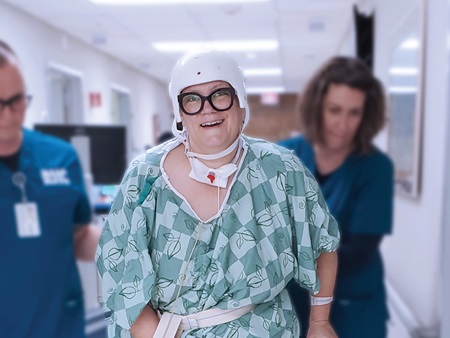
Something was horribly wrong when Gwendolyn Stangel awoke in the early morning hours after a holiday weekend. Her head was pounding and her visual field created a kaleidoscope of what she could and could not see.
Panicked, Gwendolyn called out to her husband, asking him to call 911. All she was able to get out was “Call 91 … call 91 ….”
She knew what she wanted to say, but was unable to form the words.
Taken by ambulance to the hospital, Gwendolyn immediately underwent a CT scan of her brain. The diagnosis was a ruptured aneurysm—a weakened blood vessel in her brain has stretched until it burst, allowing blood to flow freely within her skull. During the surgical procedure to repair the burst blood vessel, complications resulted in Gwendolyn having a stroke. As a result, a second surgery was necessary but caused her brain to swell, requiring the removal of a large portion of her skull to relieve the pressure.
Gwendolyn, a mother of twins, spent the next 19 days in the ICU until her doctors concluded that she was stable enough to transition to the next phase of her recovery at Regency Hospital – Minneapolis. When she arrived, Gwendolyn’s condition was complex.
Although she was not fully reliant on a ventilator to breathe through her tracheostomy tube—a medical device surgically inserted into her airway—Gwendolyn was having difficulty adjusting to the use of a speaking valve. To prevent her from inhaling food or liquids into her lungs, and to ensure she received proper medication, Gwendolyn had a feeding tube surgically inserted through the skin of her abdomen and into her stomach.
Additionally, her dominant right hand was immobile and her right leg was too weak to stand on. She also suffer from severe aphasia, which affected her ability to understand speech, and apraxia, which made it impossible for Gwendolyn to form words. Gwendolyn had to wear a helmet whenever she was out of bed to protect her brain from injury due to the removal of the skull piece.
The interdisciplinary team at Regency Hospital developed a personalized treatment plan to help Gwendolyn work toward returning home. All she wanted was to hug her family with both arms and resume her job as a paraprofessional at the local elementary school.
Treatment began on day one with evaluations by her respiratory therapist and speech-language pathologist. To demonstrate that her situation could get better, Gwendolyn’s physical and occupational therapists worked together to get her up on her feet. The nursing team partnered with the therapists to ensure Gwendolyn was upright twice a day. By doing this, her lungs and diaphragm were in a natural breathing position. Nurses monitored Gwendolyn’s vitals and maintained a close eye on her medication, but they also spent time making sure she was as comfortable as possible and that her family understood the plan for her recovery.
While maintaining optimal ventilator settings, Gwendolyn’s respiratory therapist worked toward liberating her from the machine. Every day, the therapist would conduct spontaneous breathing tests, removing most of the ventilator support and allowing Gwendolyn to try breathing on her own. As her diaphragm grew stronger, the therapist increased her time without breathing support. To further strengthen her ability to breathe on her own, and help return Gwendolyn’s ability to speak, the speech-language pathologist encouraged Gwendolyn to try using the speaking valve again. The one-way valve, when placed over the tracheostomy tube, allows air to flow in through the tube, but forces the patient to breathe out through their normal airway and over their vocal chords. After two weeks, Gwendolyn was meeting her oxygen goals and had begun to use her voice again. Her therapists were able to cap her tracheostomy tube, which forced her to use her airway while breathing in and out—Gwendolyn no longer needed a ventilator to breathe.
Though eager to resume normal communication, Gwendolyn’s speech therapist advised her family that rebuilding her ability to speak would take some time. They needed to go slowly, ask questions she was able to answer, give her options for responses and allow her time to correct mistakes. Her 12-year-old children found it difficult at first, but as the days went on and Gwendolyn’s voice became stronger, she was able to get her messages, and love, across to everyone. Then, after passing a swallow test administered by her speech therapist, Gwendolyn was cleared to begin eating regular food and thin liquids.
Growing stronger every day, the physical and occupational therapy teams began a daily regimen of exercise at the edge of Gwendolyn’s bed designed to strengthen her arms and legs and increase endurance. By lifting small weights, pushing against her therapists with her hands and feet and practicing seated marches and leg lifts, Gwendolyn regained enough strength over two weeks to begin standing with assistance.
When she discharged, 18 days after coming to Regency Hospital, Gwendolyn was breathing and eating on her own, she could walk short distances and was continuing to improve her ability to speak. The next stop in her healing journey was an inpatient rehabilitation facility and then home to her family.